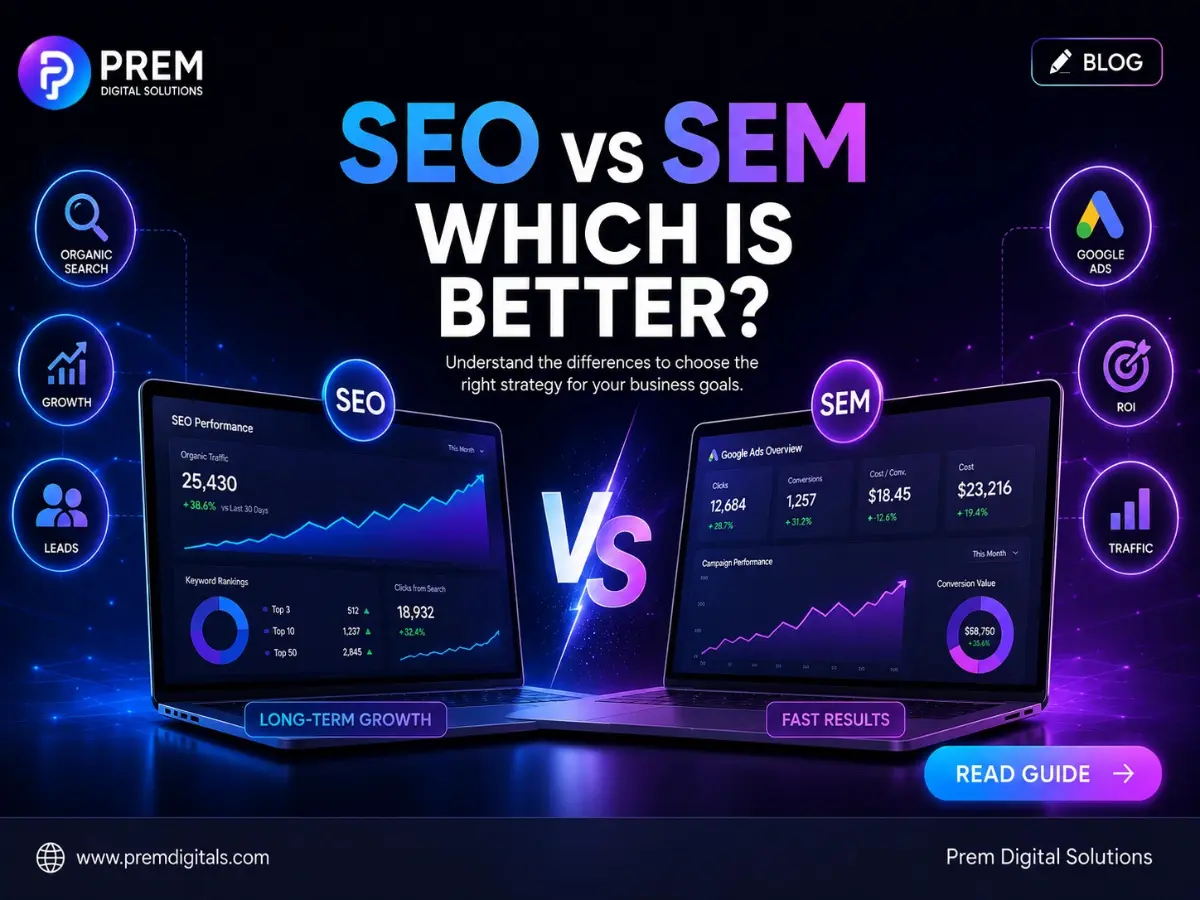
Businesses often ask whether they should invest in SEO or SEM. The answer depends on your goals, budget, competition, and how quickly you need results. While both strategies help your website appear in search engines, they work very differently. Understanding these differences helps you build a marketing strategy that delivers both immediate leads and sustainable long-term growth.
What is SEO and What is SEM?
SEO (Search Engine Optimization) focuses on improving your website so it ranks naturally in Google search results without paying for each click. It involves technical SEO, quality content, keyword optimization, backlinks, local SEO, and user experience improvements.
SEM (Search Engine Marketing) usually refers to paid advertising through platforms like Google Ads. Businesses bid on keywords so their advertisements appear at the top of search results and pay whenever someone clicks on the ad.
SEO vs SEM: Key Differences
Although both aim to increase website traffic, SEO and SEM differ in cost, speed, sustainability, and long-term value.
- SEO generates organic traffic without paying per click.
- SEM delivers instant visibility through paid advertisements.
- SEO takes several months to produce consistent rankings.
- SEM can start generating traffic immediately after campaigns launch.
- SEO provides long-term ROI and continues working even without daily spending.
- SEM stops producing traffic once the advertising budget ends.
Advantages of SEO
SEO builds long-term authority and trust. Users often trust organic search results more than advertisements, leading to higher credibility and better conversion rates.
A properly optimized website continues attracting visitors for months or years, making SEO one of the highest-return investments in digital marketing.
Advantages of SEM
SEM is ideal when businesses need immediate leads, product launches, seasonal promotions, or rapid market testing. Google Ads allows precise targeting based on location, interests, demographics, and search intent.
Campaign performance can be measured instantly, allowing marketers to optimize keywords, budgets, and landing pages quickly.
When Should You Choose SEO?
SEO is the better investment if you want sustainable growth, long-term visibility, and lower customer acquisition costs. Local businesses, service providers, and companies planning for the future benefit greatly from SEO.
- You want long-term organic traffic.
- You have time to build authority.
- You want lower marketing costs over time.
- You want to rank for multiple keywords.
- You want customers to find your business naturally.
When Should You Choose SEM?
SEM is suitable when speed matters. New businesses, product launches, events, and limited-time offers often benefit from paid advertising because results begin almost immediately.
- You need leads immediately.
- You're launching a new business.
- You're running seasonal promotions.
- You have a dedicated advertising budget.
- You want fast testing of products or services.
The Best Strategy: Combine SEO and SEM
Rather than choosing one over the other, successful businesses combine both strategies. SEM generates immediate traffic while SEO gradually builds authority and reduces long-term advertising costs.
Running both together creates a balanced digital marketing strategy where paid campaigns drive quick results and SEO ensures sustainable growth over time.
Final Thoughts
SEO and SEM are not competitors—they are complementary strategies. If your business needs immediate visibility, SEM is the fastest route. If you want lasting online success, SEO is essential. Combining both provides the strongest foundation for consistent lead generation, improved brand visibility, and long-term business growth.
Frequently asked questions
Which is better, SEO or SEM?
Neither is universally better. SEO is ideal for long-term organic growth, while SEM provides immediate visibility through paid advertising.
How long does SEO take to show results?
Most businesses begin seeing measurable improvements within 3 to 6 months, depending on competition and website quality.
Is Google Ads part of SEM?
Yes. Google Ads is one of the most widely used SEM platforms and helps businesses appear at the top of search results instantly.
Should small businesses invest in SEO or SEM?
Small businesses benefit most from combining both. SEM generates quick leads, while SEO builds sustainable traffic and reduces future advertising costs.